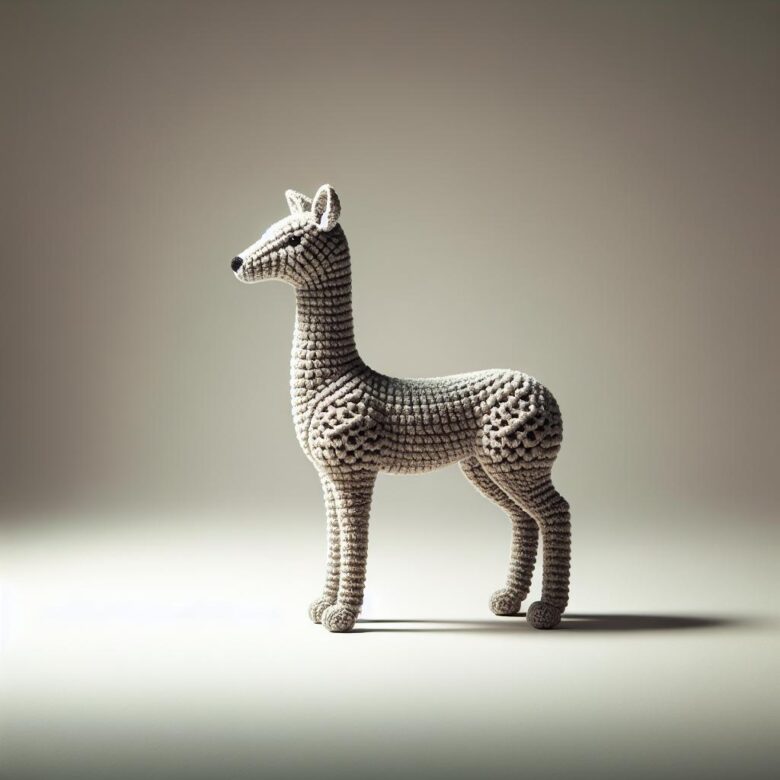
Realistic amigurumi depends less on adding more stuffing and more on controlling where the crocheted fabric gains height, width, and tension. A convincing head, muzzle, paw, or torso is usually built through several small decisions: localized increases, staggered decreases, short rows, staged stuffing, accurate assembly, and restrained needle sculpting.
The methods below use US crochet terminology. Sc means single crochet, inc means two single crochets in one stitch, and invdec means an invisible single-crochet decrease.
Plan the Form Before Changing the Stitch Count
Before crocheting an unfamiliar shape, study it from the front, side, and top. A side view may show a projecting muzzle, while the front view reveals whether that muzzle is narrow, broad, or tapered. Designing from only one angle often produces a piece that looks correct in profile but flat or crooked from the front.
Create a simple shape map with four reference lines:
- Center front and center back: Keep these marked independently from the beginning-of-round marker.
- Widest point: Mark where the cheeks, shoulders, hips, or paws reach maximum width.
- Projection point: Identify the forehead, chest, belly, muzzle, or joint that must extend farther than the surrounding fabric.
- Taper point: Decide where the form narrows into the neck, wrist, ankle, or nose.
A running stitch marker helps track the start of each spiral round, but it should not be treated as the anatomical center. Single crochet worked in a spiral naturally leans, so facial features and shaping zones should be positioned relative to the center-front marker rather than the round boundary.
| Desired change | Primary technique | What to watch |
|---|---|---|
| Add width around the whole form | Evenly distributed increases | Regularly stacked increases can create a polygonal outline. |
| Add volume to one side | Localized increases or short rows | Check the opposite side to make sure it remains on-axis. |
| Create a gradual taper | Staggered invisible decreases | Rapid decreases may form dents or reveal stuffing. |
| Create a defined fold or flat sole | Front-loop-only or back-loop-only shaping | The unused loops form a visible ridge, so place it deliberately. |
| Indent a socket, toe split, or muzzle line | Needle sculpting or internal tacking | Excess tension can distort stitches or cut into soft yarn. |
Build Curves with Controlled Increases and Decreases
Each single-crochet increase adds one stitch to the circumference, while each decrease removes one. The location of that change determines where the fabric expands or contracts.
Use localized increases to direct volume
For a muzzle base, cheek, chest, or haunch, place several increases within the relevant shaping zone instead of spacing every increase around the full round. Keep at least one ordinary stitch between increases when possible; placing many increases directly beside one another can create ruffling or a hard corner.
On the next shaping round, move the increase points slightly rather than working directly into the previous increases. This distributes the added fabric and reduces visible vertical ridges. An even round between shaping rounds can help settle the contour and make it easier to evaluate.
The following is a planning example rather than a complete pattern:
| Stage | Stitch action | Purpose |
|---|---|---|
| Establish the form | Work an even round at 36 stitches | Provides a stable reference circumference. |
| Widen the front | Place four increases across the front shaping zone | Raises the count to 40 and adds fabric near the muzzle or cheeks. |
| Set the curve | Work one even round | Lets the new width extend without immediately changing direction. |
| Narrow the underside | Place two invisible decreases near the lower center | Begins a jaw or chest taper without narrowing the top equally. |
The exact stitch count and spacing must be adjusted for the yarn, gauge, and intended anatomy. Pause after each shaping round and inspect the piece from multiple angles before adding more changes.
Use invisible decreases for smoother tapers
To make an invisible decrease, insert the hook under the front loop of each of the next two stitches. Yarn over and pull through both front loops, then yarn over and complete the single crochet. This leaves the back loops undisturbed and usually produces a less obvious indentation than a standard decrease.
Stagger decreases from one round to the next. If every decrease sits directly above the previous one, the surface may develop grooves. When a pattern requires a strong anatomical crease, however, intentionally aligned decreases can be useful along an inner elbow, under a jaw, or at the back of a knee.
Change stitch height carefully
A short section of half double crochet can add height to a brow, back, belly, or upper paw. Transition gradually—single crochet, half double crochet, then single crochet—rather than jumping abruptly between very short and tall stitches. Taller stitches are more open, so they may expose stuffing when worked with a loose gauge.
Use Short Rows to Add Height Without Widening the Entire Piece
Short rows are partial rows worked over only part of the round. They add fabric length to a selected area, making them useful for a sloped forehead, curved back, projecting chest, rounded belly, or bent joint.
- Mark the center of the area that needs more height.
- Place boundary markers on both sides of that area.
- Work to the first turning point, turn as directed, and crochet back across the marked zone.
- On later passes, move the turning points inward for a compact dome or outward for a broader slope.
- Resume the full round without adding an accidental stitch into each turning chain.
Short-row construction varies, especially when switching between spiral rounds and turned rows. Record whether the turning chain counts as a stitch and count the first complete round carefully. An unexplained extra stitch at either turning point can shift the entire face or torso off-center.
Turning also reverses the visible orientation of the stitches. On smooth yarn, that texture change may be noticeable. Place transitions under a muzzle, along the underside, or beneath brushed fibers when possible. Small gaps at the turns can be reduced by keeping the first and last stitches snug, but pulling too tightly may create a dent.
Choose Fabric That Can Hold the Sculpted Form
A smaller hook than the yarn label suggests is often useful for amigurumi, but there is no universal hook-size reduction. Make a small swatch or sample cup and stretch it over stuffing. If the filling shows through, try a smaller hook, a firmer yarn, or a denser stitch technique. If the fabric is so tight that increases and decreases are difficult to work, move up a hook size rather than forcing the stitches.
- Smooth, firmly spun yarn: Shows shaping and embroidered details clearly, but also reveals uneven tension.
- Fuzzy or brushed yarn: Softens transitions and seams, although it makes stitch counting and frogging harder.
- Cotton: Produces defined stitches and crisp forms but has less rebound than many acrylic yarns.
- Elastic or loosely plied yarn: Can distort under firm needle sculpting, so use lighter pulling tension.
Maintain the same yarn-over or yarn-under method throughout the piece. Switching methods changes stitch width and appearance, which can make matching limbs or facial halves look different even when their stitch counts agree.
Stuff in Layers Instead of Correcting the Shape at the End
Stuffing supports the crocheted structure; it cannot fully correct shaping placed in the wrong location. Add small tufts as the piece develops rather than pushing one large bundle through a nearly closed opening.
- Fill narrow tips first, including paws, muzzles, and the ends of limbs.
- Use small overlapping tufts to avoid hard lumps.
- Keep the surface layer smooth and moderately soft.
- Add firmer support at load-bearing areas such as the neck, hips, and base of a seated figure.
- Rotate the piece after each addition and compare the front, side, and top views.
A blunt stuffing tool can move fiber into corners without splitting the yarn. Hemostats can be useful in narrow openings, but serrated jaws may catch fibers or pull loops through the fabric.
If a hollow area remains, remove and redistribute the surrounding fill before adding more. Continually packing extra fiber into one spot often creates a hard bulge beside the original dip. Overstuffing can also spread decreases, expose filling, round off intended planes, and push paired limbs away from their planned angles.
Align Features and Limbs Before Sewing
Symmetry begins with fixed reference points, not visual guessing. Use contrasting yarn markers to identify the center front, center back, eye line, shoulder line, and limb attachment rounds. Count outward from those markers to position paired features.
Pin all major components before sewing any of them permanently. Set the figure on a flat surface and inspect it from the front, back, both sides, and above. A limb may appear correct from the front while pointing forward or backward in profile.
For a stuffed muzzle or separate cheek piece, sew most of the seam first, add the final small amount of stuffing through the remaining gap, and then close it. This gives more control than fully stuffing the part before attachment. Match rows as well as stitches so one side is not stretched farther than the other.
Intentional asymmetry can make an animal look more natural, but establish a balanced base first. A slightly tilted ear or uneven brow reads as expression only when the underlying eyes, jaw, and head axis remain controlled.
Sculpt Faces and Paws with Thread
Needle sculpting creates indentations by drawing two or more surface points toward an internal anchor. It is effective for eye sockets, the division between cheeks, nostril placement, paw pads, and toe separations.
- Finish the main stuffing and mark paired pull points with pins.
- Thread a long doll needle with strong polyester sewing, button, or upholstery thread in a suitable color.
- Enter at a concealed point, such as the back of the head or beneath the muzzle.
- Pass through the stuffing to the first marked point, then travel to its paired point.
- Pull only until a shallow indentation appears.
- Repeat on the opposite side and compare before tightening further.
- Secure the thread with small stitches in a hidden area and bury the tail inside.
Several light passes are safer than one forceful pull. Strong thread can cut into soft yarn or create a deep channel if overtightened. Needle sculpting removes apparent volume; it cannot create a brow or cheek that lacks enough fabric. Add a small crocheted or felt-backed form beneath the surface when projection is needed.
Keep Color Lines and Seams on the Intended Axis
Color placement affects how the viewer reads the shape. A marking that drifts sideways can make a straight muzzle or chest appear twisted even when the stuffing is balanced.
For a basic color change, complete the final yarn-over of the previous stitch with the new color. Keep the transition on an underside or rear axis when the design allows. Because spiral rounds create a visible step, a perfectly level band may require joined rounds, a planned jog-reduction method, or embroidered surface color instead.
Do not pull color-change tails so tightly that they indent the fabric. Weave them securely on the inside in more than one direction; merely crocheting over a short tail may not hold slippery yarn over time.
Use Internal Supports Only When the Project Allows Them
Internal structure can hold long necks, flat ears, thin legs, or display poses, but it changes the durability, washability, and intended use of the finished piece.
- Felt stiffeners: Layers of firmly sewn felt can support ears, tails, fins, or a muzzle without adding a hard edge.
- Plastic canvas: Can create a flat internal plane, but cut edges should be rounded and fully covered so they cannot abrade the crochet fabric.
- Weighted bases: Plastic or glass pellets should be enclosed in a tightly woven, securely sewn inner pouch before insertion. Surround the pouch with fiberfill so its outline does not show.
- Wire armatures: For a poseable display figure, use a continuous armature with looped, covered ends and padding between the wire and crochet. Repeated bending can fatigue wire, so inspect the piece rather than assuming it will remain secure indefinitely.
Avoid wire, loose pellets, plastic canvas, safety eyes, and other hard or detachable components in items intended for babies or children who may mouth or roughly handle the toy. Embroidered features, washable fiberfill, and fabric-based shaping are the more conservative choices. If the finished item will be sold or given as a child’s toy, account for the product-safety requirements that apply where it will be distributed.
Troubleshooting Realistic Amigurumi Shapes
| Problem | Likely cause | Adjustment |
|---|---|---|
| The head looks faceted | Increases are stacked in vertical columns. | Offset shaping points on later rounds and add an even round between major expansions. |
| The muzzle looks like a beak | Too much length was added at one narrow point. | Broaden the base with side increases or wider short rows; reduce stuffing at the tip. |
| One cheek is larger | Markers drifted or stuffing density differs. | Recount from the center-front marker and redistribute stuffing before adding needle sculpting. |
| Decreases leave holes | Loose gauge, standard decreases, or excessive stuffing pressure. | Use invisible decreases, reduce the hook size if practical, and remove a small amount of stuffing. |
| The neck bends after assembly | Insufficient support or an off-center seam. | Add firmer layered stuffing at the neck base and pin the head on both axes before resewing. |
| Paired limbs twist differently | The spiral start or attachment points were treated as anatomical centers. | Mark front-facing stitches on both limbs and align those marks during assembly. |
| Needle-sculpted eyes look startled | Pulls are too deep, too close together, or uneven. | Release the thread if possible and rebuild the sockets with shallower alternating passes. |
| A flat area keeps becoming round | Uniform stuffing is pushing equally in every direction. | Use thinner surface layers, internal tacking, or a fabric stiffener appropriate to the project. |
A Simple Shaping Exercise
To see how placement changes form, crochet two identical sample cups until each has 24 or 30 stitches. On the next round of the first cup, distribute four increases evenly. On the second, place the same four increases across only the front half, separated by ordinary stitches. Work one even round on both and add equal amounts of stuffing.
Compare the samples from above and from the side. Both contain the same number of stitches, but the localized increases direct more fabric toward one area. Mark the center lines, increase points, and stuffing level on each sample; these small forms can serve as practical references when planning a muzzle, chest, belly, or haunch.
For a finished piece, evaluate the silhouette after every meaningful shaping change. It is easier to move an increase, loosen a sculpting thread, or redistribute stuffing while the work is open than to correct the entire form after assembly.

The Cozy Stitch Editorial Team creates practical crochet guides for beginners and everyday makers. Our content covers stitches, yarn and hook selection, pattern reading, troubleshooting, amigurumi, handmade gifts, and functional projects for the home. Guides are reviewed for clarity, usefulness, and accuracy and may be updated when improvements are needed.