
Basic crochet stitches are simple movements, but neat fabric depends on three related skills: inserting the hook in the correct place, keeping the stitch count steady, and following the pattern’s turning-chain rule. Uneven practice swatches are normal while those movements become familiar.
This guide uses US crochet terminology. Before beginning any pattern, check whether it uses US or UK terms and whether its turning chain counts as a stitch. A pattern’s instructions take priority over general conventions.
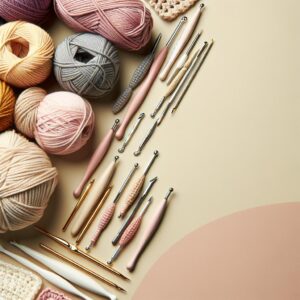
Choose yarn and a hook that make practice easier
A smooth, light-colored yarn makes it easier to see the top of each stitch. Very dark, fuzzy, or loosely plied yarn can hide the loops or split when the hook enters it.
- Yarn: Choose a smooth yarn in a solid color. A medium-weight yarn is comfortable for many beginners, but any easy-to-see yarn can work.
- Hook: Use the hook size suggested on the yarn label as a starting point. The final choice depends on the fabric and gauge required by the pattern.
- Stitch markers: Locking markers, safety-pin-style markers, or short pieces of contrasting yarn can identify the first and last stitches.
- Other tools: Keep scissors and a yarn needle nearby for finishing.
Hold the hook securely without squeezing it. The working loop should rest on the hook’s shaft, which controls its size, rather than being pulled tightly into the narrower throat.
Learn the parts of a crochet stitch first
Knowing what to look for is as important as memorizing the hook movements.
- Working loop: The loop currently on the hook. It does not count as a stitch.
- Top loops: Most completed stitches have a V shape across the top. The side nearest you is the front loop; the other side is the back loop.
- Post: The upright body below the top V.
- Turning chain: One or more chains made at the beginning or end of a row to bring the hook to the height of the next row. It may or may not count as a stitch.
- Yarn over (yo): Bring the working yarn over the hook so it can be pulled through a loop or stitch.
Unless a pattern says to work in the front loop only, back loop only, around a post, or into a space, insert the hook under both top loops of the stitch.
The five essential beginner crochet stitches
| Stitch | US abbreviation | Relative height | Common uses |
|---|---|---|---|
| Chain | ch | Foundation or spacer | Starting rows, turning, open spaces |
| Slip stitch | sl st | Very low | Joining rounds, moving across stitches, edging |
| Single crochet | sc | Short | Dense fabric, amigurumi, borders, practical accessories |
| Half double crochet | hdc | Medium | Warm fabric with more drape and height than sc |
| Double crochet | dc | Tall | Blankets, scarves, garments, granny-style patterns |
Stitch height and fabric density also depend on the yarn, hook size, and individual tension. The comparisons above are relative, not fixed measurements.
1. Chain stitch
The chain forms the foundation of many flat projects and creates turning chains and spaces within a pattern.
- Make a slip knot and place it on the hook.
- Yarn over.
- Pull the yarn through the loop on the hook. One chain is complete.
- Repeat the yarn-over and pull-through movement for the required number of chains.
Count the V shapes in the chain. Do not count the slip knot or the working loop on the hook.
If the foundation chain is too tight: Keep each new loop on the shaft of the hook before making the next chain. For a practice swatch, it can also help to make the foundation with a slightly larger hook and then switch back, but check that this does not distort the project’s gauge.
A foundation chain can be worked through one of its top loops or through the raised back bump. Working into the back bump leaves an uninterrupted row of V shapes along the lower edge, although the bumps may be tighter and harder to enter. Follow the pattern when it specifies a method.
2. Slip stitch
A slip stitch joins or moves the working position without adding much height.
- Insert the hook into the indicated stitch or space.
- Yarn over.
- Pull the yarn through the stitch and through the loop already on the hook in one movement.
A common mistake is pulling slip stitches so tightly that the next stitch becomes difficult to enter. Let the new loop return to the hook’s shaft before continuing. When joining a round, check whether the pattern says to join to the first stitch, a beginning chain, or another marked location.
3. Single crochet
Single crochet makes a compact fabric and is particularly useful for learning to recognize the first and last stitches of a row.
- Insert the hook under both top loops of the indicated stitch.
- Yarn over and pull up a loop. There are two loops on the hook.
- Yarn over and pull through both loops.
For a basic foundation row, it is common to place the first single crochet in the second chain from the hook. The skipped chain provides room to turn and normally does not count as a single crochet, but the pattern should confirm its counting rule.
If the sides begin to narrow, the last stitch is often being missed. Mark the first and last single crochet as soon as each is made, then count the top V shapes before starting the next row.
4. Half double crochet
Half double crochet is taller than single crochet but denser than double crochet.
- Yarn over once.
- Insert the hook under both top loops of the indicated stitch.
- Yarn over and pull up a loop. There are three loops on the hook.
- Yarn over and pull through all three loops.
Beginning a practice row in the third chain from the hook is a common approach. For later rows, patterns often use a chain two, although designers differ on whether it counts as the first half double crochet.
If pulling through all three loops feels difficult, check that the loops have not tightened around the hook’s throat. Rotate the hook tip slightly downward during the pull-through, taking care not to split the yarn.
5. Double crochet
Double crochet adds height in two pull-through stages, producing fabric that generally works up faster and has more open space than single crochet.
- Yarn over once.
- Insert the hook under both top loops of the indicated stitch.
- Yarn over and pull up a loop. There are three loops on the hook.
- Yarn over and pull through two loops. Two loops remain.
- Yarn over and pull through the final two loops.
For a foundation row, the first double crochet is commonly placed in the fourth chain from the hook. Those skipped chains may count as the first double crochet, depending on the pattern.
Keep the three loops at a similar size before starting the first pull-through. If the pulled-up loop is repeatedly shortened, the row can become stiff and the double crochets may lose their expected height.
How turning chains affect straight edges
Crooked sides are often counting problems rather than stitch problems. The key is to decide whether the turning chain occupies the first stitch position and then apply that rule for the entire section.
| Stitch | Common turning approach | Important caution |
|---|---|---|
| Single crochet | Chain 1 | Commonly does not count; work the first sc in the first stitch. |
| Half double crochet | Often chain 2 | It may count or not count. Check the pattern. |
| Double crochet | Often chain 3 | It frequently counts, but shorter chains and non-counting methods are also used. |
When the turning chain counts as a stitch
- The chain occupies the first stitch position.
- Do not place another stitch in the same stitch at the base of the chain unless instructed.
- At the opposite edge of the following row, work into the top of the turning chain.
- Place a marker in the top chain so it is easy to find later.
When the turning chain does not count
- Work the first full stitch into the first stitch of the previous row.
- Do not include the turning chain in the row count.
- At the opposite edge, work into the last full stitch rather than the turning chain unless instructed otherwise.
Do not switch between counting and non-counting methods midway through a project. If the pattern is unclear, inspect its stitch totals and any chart or progress photographs before continuing.
Count stitches without losing your place
Count the V shapes along the top edge after completing each row. For a long row, place markers at regular intervals and record the total in the pattern margin, a notebook, or a row-counter app.
Markers at the edges are especially valuable because the last stitch may be pulled sideways and resemble part of the turning chain. Move each marker into the newly completed edge stitch as the row progresses.
Consider this example:
Row 2: Ch 1, turn. Sc in first st and in each st across. (20 sc)
This instruction means to make one turning chain, turn the work, place the first single crochet in the first stitch, and continue across. The parenthetical note gives a total of 20 single crochets; the chain one is not included.
Troubleshoot common beginner crochet problems
| Problem | Likely cause | What to check |
|---|---|---|
| Rows become narrower | The first or last stitch is being skipped | Count the top V shapes and mark both edge stitches. |
| Rows become wider | An extra stitch is being made at an edge | Check whether both a counting turning chain and a stitch in its base were worked. |
| Edges slant but the count is correct | Stitch or turning-chain height is changing | Keep loops on the hook shaft and use the same turning method on every row. |
| Foundation edge bows or pulls inward | The starting chains are tighter than the stitches above | Remake the chain more loosely or use a slightly larger hook for the foundation. |
| There is a gap beside the turning chain | A tall counting chain naturally leaves space, or the first stitch was misplaced | Verify the pattern’s counting rule before changing the chain height. |
| The hook will not pass through loops easily | The loops are too tight or the yarn is splitting | Relax the working loop onto the shaft and insert through the intended loops without catching individual plies. |
| Fabric is stiff or unexpectedly loose | Hook size, yarn choice, or tension does not match the pattern gauge | Make and measure a gauge swatch, then change hook size if needed. |
If the stitch count is already wrong, unraveling to the last correct row is usually the cleanest repair. Blocking can help settle stitches and shape appropriate fibers, but it cannot replace a missing stitch or remove an accidental increase.
Understand basic pattern abbreviations
| Abbreviation | Meaning |
|---|---|
| ch | Chain |
| sl st | Slip stitch |
| sc | Single crochet in US terms |
| hdc | Half double crochet in US terms |
| dc | Double crochet in US terms |
| st or sts | Stitch or stitches |
| sp | Space |
| sk | Skip |
| rep | Repeat |
| yo | Yarn over |
Asterisks, parentheses, and brackets commonly identify repeated instructions or stitch totals, but their exact use varies. Read the pattern’s abbreviation key and notes instead of assuming every designer uses identical punctuation.
US and UK stitch names
| US term | UK equivalent |
|---|---|
| Single crochet (sc) | Double crochet (dc) |
| Half double crochet (hdc) | Half treble crochet (htr) |
| Double crochet (dc) | Treble crochet (tr) |
The stitch movements are equivalent; the names differ. Chain and slip stitch use the same basic names in both systems. Always identify the terminology before choosing yarn, calculating gauge, or beginning the first row.
Make a stitch sampler with controlled edges
This sampler uses 20 stitches throughout and deliberately practices two turning-chain conventions. Keep a marker in the first and last counted stitch.
- Foundation: Chain 21 loosely.
- Row 1: Single crochet in the second chain from the hook and in every chain across. Count 20 single crochets.
- Rows 2–4: Chain 1 and turn. The chain does not count. Single crochet in the first stitch and every stitch across. Count 20 after each row.
- Rows 5–7: Chain 2 and turn. For this sampler, the chain does not count. Half double crochet in the first stitch and every stitch across. Count 20.
- Row 8: Chain 3 and turn. For the double-crochet section, this chain counts as the first stitch. Mark its top, skip the first half double crochet at the base of the chain, and double crochet in the remaining 19 stitches.
- Rows 9–10: Chain 3 and turn, counting it as the first double crochet. Mark its top, skip the stitch at its base, and double crochet across. Place the final double crochet in the marked top of the previous row’s chain 3. Count 20 stitches, including the current turning chain.
Label the finished sampler with the yarn name, fiber content, hook size, and turning-chain choices. The goal is not a perfectly square piece; it is to recognize each stitch, maintain the count, and understand why the edges behave differently.
Choose a first project based on the fabric you want
- Choose single crochet for a dense, sturdy fabric and plenty of stitch-placement practice.
- Choose half double crochet for a balance of warmth, height, and moderate drape.
- Choose double crochet when a project needs more height or a more open fabric.
- Practice slip stitches on a small project worked in joined rounds or one with a simple border.
Before moving to shaping, color changes, or complex stitch patterns, aim to identify every top V, explain whether the turning chain counts, and complete several rows without changing the stitch total. Those skills make later crochet instructions much easier to follow.

The Cozy Stitch Editorial Team creates practical crochet guides for beginners and everyday makers. Our content covers stitches, yarn and hook selection, pattern reading, troubleshooting, amigurumi, handmade gifts, and functional projects for the home. Guides are reviewed for clarity, usefulness, and accuracy and may be updated when improvements are needed.